


I’ve been writing about dubious cancer clinics that provide unproven (and disproven) cancer therapies, cash (or credit card) on the barrelhead, since the very beginning of this blog in 2008. These clinics tend not to be located in the US, preferring more—shall we say?—regulation-poor countries like Mexico or nations in Central America, Asia, and the former Soviet Union, or in certain European countries with a lax attitude towards clinics such as the Hallwang Private Oncology Clinic in Bavaria. That’s not to say that such clinics don’t exist in the US. After all, I’ve been writing about Stanislaw Burzynski and his antineoplaston quackery for well over 15 years now, and his clinic still functions in Houston, with Burzynski himself still quacking strong at age 83. Ever since the pandemic and the rise of the “make America healthy again” (MAHA) movement, I’ve paid less attention to such clinics than I used to do before 2020. So, when I came across a story in the New York Times Magazine this weekend by Trisha Thadani documenting how her father, Rajeev Thadani had been enticed by just such a clinic to treat his stage IV lung cancer, I saw an opportunity to revisit this subject. (Spoiler alert: Sadly, Mr. Thadani died of his disease.) I even approved of the title, something that is often not true as legacy media like the NYT is often too cautious to be too blunt: Dying Patients Are Inundated by Misinformation. My Dad Was One of Them, with the tagline: “Cancer patients are being persuaded to spend tens of thousands on unproven treatments by alternative-medicine clinics.”
Yes, they are. And they have been preyed upon this way for many decades. Indeed, as I read the very sad story of Rajeev Thadani, I kept thinking that the clinic where he went, Envita Medical Centers in Arizona, sounded very much like Hallwang Private Oncology Clinic in Bavaria, only that it was trying even harder to appear scientific in its approach, even though, right on its website, it answers the question of whether it does clinical trials thusly:
Envita has done clinical trials in the past but does not do clinical trials currently, due to several reasons. Dr. Dino Prato and Dr. John Oertle discuss how clinical trials are important for the discovery of a new drug, but at Envita Medical Centers and Center of Excellence, the focus is not on one single therapy, drug, or treatment. The world class integrative center for precision oncology aims to enhance treatment options for cancer patients by utilizing cutting-edge combination treatments, which include immunotherapy, proprietary interventional radiology procedures, genetically targeted chemo agents, and integrative adjuvants. We aim to provide a greater selection of treatments based on each patient’s genomics, as opposed to putting all our efforts and hopes into a single drug to produce a response to care.
In other words, no. Envita doesn’t do clinical trials. Instead, the doctors there “work towards providing a revolutionary treatment plan by going beyond the limitations of large sample clinical trials that have a rigid framework of who can or cannot qualify for them” and utilize “a multi-pronged precision oncology plan based on the n-of-1 clinical trial model, as well as our advanced algorithms which have been developed over the course of two decades in helping late-stage cancer patients respond to care. Our proprietary precision testing guides us to the most suitable agents for treating each patient’s cancer and its microenvironment to help with their holistic recovery.” Sure, whatever. Because some random clinic in Arizona has surpassed the greatest cancer centers in the world in developing these algorithms, which are so awesome that the doctors there don’t think they can do clinical trials because they just know they’re curing patients. This is, of course, my interpretation of what they are saying based on many years of hearing very similar claims, including Burzynski’s own touting of “personalized gene-targeted therapy” 15+ years ago.
And guess what? The clinic also states that it takes “advantage of the expanded right to try law to utilize the latest in conventional medicine, including drugs and therapies that are still in the clinical trial phase, and combine them with precision genomic chemotherapy, immunotherapy, and integrative agents,” doing exactly the sort of thing I was warning about all those years ago when right-to-try first reared its ugly head: Using it as a get-out-of-jail-free card to justify using whatever “experimental” therapies they want to profit from.
I’ll get back to these issues that facilitate the existence of clinics like Envita, and you’ll love their other justification for not doing clinical trials of their dendritic cell therapy. However, first let’s center this story on the victim, Rajeev Thadani, and his story told through his surviving daughter. The story, besides showing once again how these sorts of clinics exist and profit by charging desperate dying cancer patients tens or even hundreds of thousands of dollars for unproven treatments, plus a lot of “alternative medicine.”
Rajeev Thadani: Modern medicine vs. “holistic” care?
Reading the story of Rajeev Thadani depressed the hell out of me, because I’ve read so many similar stories and blogged on a number of them over the years. That’s why I’m going to quote directly the first few paragraphs of the story:
My mom was making lunch when she heard a thump come from the bedroom. She ran upstairs and found my dad face down on the carpet, blood seeping from a gash under his eye.
For days, he had been feeling lightheaded and fatigued since receiving a round of chemotherapy at Memorial Sloan Kettering Cancer Center. He was sitting on the edge of the bed when suddenly, he told my mom, everything went black. Thump. As my mom struggled to lift him from the ground, he vowed that he was done — done with Western doctors, who he said were “crooks” and “quacks”; done with “poisons” coursing through his body; done with sickening treatments he didn’t believe in.
“I’m going to die if I keep doing this,” he told her.
That evening, with a bruised eye and a stiff neck, my dad decided to book a flight from New Jersey to Arizona so he could check out a clinic he had found on the internet. On its website at the time, the clinic, Envita Medical Centers, said that its unique protocol had helped patients “outperform other renowned cancer centers for nearly two decades.” Its “proprietary” chemotherapy treatment was “so gentle,” it said, “that many patients report being able to hike and exercise” during care. My dad believed this outpatient clinic — which cost nearly $10,000 a week — could save him from the Stage 4 lung cancer ravaging his body.
How many times have I read variants of this sort of patient anecdote? I’ve lost track. Usually, they don’t start quite so dramatically, with a fall and a head injury leading the patient to decide to go down the alternative cancer cure path, but the beats are all there: a patient with a terminal cancer, tiredness and hopelessness undergoing conventional therapies for their disease, and the search for “alternatives” that leads to the patient finding the one clinic that gives him hope through patient testimonials. Also, the clinic charges huge sums of money for its treatments and doesn’t take health insurance. This narrative sounds just like the narratives I’ve encountered for cancer patients such as Pauline Gahan, a British woman who spent £300,000 at the Hallwang clinic to treat her metastatic cancer, or any of the many patients attracted to the Burzynski Clinic from the UK and US. It’s the business model of these clinics. They offer “hope” to patients who have cancers that are not treatable for cure using conventional therapies, cancers like stage IV lung cancer, although Burzynski did seem to specialize in terminal brain tumors.
They also often offer something that, I’ve admitted many times, conventional hospitals and clinics can lack: the human touch. In the US, the reason tends to be underpayment for services by third-party payers and our for-profit healthcare system; in countries with universal health insurance, it tends to be because of underinvestment in the healthcare system, as has been happening in Canada. Thadani describes it herself, and I have experienced it dealing with my parents and the medical system when both of them were experiencing declining health simultaneously in the months and years before they died. Her father was initially treated at Memorial Sloan-Kettering Cancer Center, arguably the premier cancer center in the US, if not the world, and this is what she described in an accompanying interview with Adam Kushner, editor of the NYT The Morning newsletter:
I texted a friend at the time: “The staff has been so rigid and unpleasant”; a doctor “made us feel like a burden”; “one nurse didn’t even look up from her computer!” Those moments really add up. But I have to give a disclaimer that my dad was a difficult patient. He went into his oncology appointments after spending hours researching alternatives. He did not want to be there and didn’t stay.
Who among us hasn’t experienced these little indignities, or even much worse, when dealing with the healthcare system? Now contrast that to how Thadani describes in the same interview what happened at Envita:
I was very skeptical, but I felt reassured as soon as we got there. During our first visit, a naturopathic medical doctor sat with us for nearly four hours to explain their unique treatment regimen. It seemed so promising that I started to think my dad would actually beat his disease. I was thrilled at how much better my dad looked during his first weeks at the clinic. He finally had hope, and that was having a real effect on his mood and energy.
Of course, stopping chemotherapy allows the adverse effects of the chemotherapy to wear off, and patients often feel better after that. Their cancer is still growing, though. It just hasn’t hit the point where it’s causing horrendous symptoms. Again, this is a very common feature of alternative cancer testimonials. Also, the practitioners at such clinics spend lots of time with patients, largely because they are able to because their payment doesn’t depend on what insurance companies or government payers like Medicare will reimburse them for. The contrast with conventional medical facilities is often just that jarring.
Moreover, Mr. Thadani was very much predisposed to distrust conventional medicine, as is documented in the story:
The modern medical system reminded him of all he learned to fear from his own father, an Indian homeopath, who worked at an alternative-medicine practice in Midtown Manhattan. Patients traveled from across the country to see my grandfather after finding him through televised interviews and a lecture series, where he disseminated his views that vaccines are dangerous and American children overmedicated. He also taught his audience about the healing power of homeopathy, an unproven alternative medical practice developed in the late 1700s.
It was this distrust that led Mr. Thadani to ignore evidence of early-stage cancer incidentally found on a CT scan done to screen for cardiac disease in early 2019. You can picture the sort of man Mr. Thadani was, as I see elements of my father’s behavior in him. According to the story, the only reason Mr. Thadani agreed to get the scan was because his wife had basically forced him to do it after having heard from a friend how he had undergone such a scan and been found to be at imminent risk for a heart attack. The results were:
The scan, which cost them each $750 out of pocket, revealed mostly healthy hearts but showed a concerning image in my dad’s lungs: “interstitial lung disease prominent in the lung apices” and “a nodule of ground glass lesion in the superior segment left lower lung,” according to the report. The doctor called five days later, on a Saturday morning, to implore my dad to get it checked out. “Don’t ignore this,” my mom remembers him saying. My dad smoked several Marlboro cigarettes a day for some 40 years, but with no symptoms at the time, he dismissed the results as unnecessary hysteria from a doctor.
Given that Mr. Thadani had been a smoker for decades before, albeit a light smoker who only smoked “several cigarettes a day,” you can see how such a finding would be very concerning. Several months later, Mr. Thadani developed a dry cough and, instead of following up on the concerning findings on his chest CT, went to his homeopath, who “initially suggested that he try rubbing castor oil under his arms and also take Carbo Vegetabilis, a remedy typically used for indigestion.” Mr. Thadani’s symptoms continued to progress until he was unable to make it all the way up a single flight of stairs without stopping to catch his breath. This finally pushed him to see a pulmonologist, who did a bronchoscopy and diagnosed multiple cancers in his lungs. His family managed to persuade him to go to MSKCC, although there’s an anecdote in the story about how his wife woke up in the middle of the night and found him not in his bed, but at the computer “looking for alternatives.”
Given this, it should perhaps not be surprising that, for all the effort Ms. Thadani, her mother, and her brother put into persuading Mr. Thadani not to fly to Arizona to be treated at Envita, he only made it through one round of chemotherapy, which led to him saying that he “felt so horrid that he vowed to never go back,” after the incident that started the story, in which he fell and split open his scalp.
From here on out, I’m going to try to be a lot more strategic quoting the news story, because you really should read it for yourself, but I will summarize Mr. Thadani’s story and course at Envita, first noting that Envita was not the first clinic that had interested him. He was first interested in a clinic in Florida, “whose treatment plan of ‘nontoxic’ alternatives cost $4,000 to $5,000 a week,” but didn’t go when he learned that the clinic’s lead doctor would have multiple complaints lodged against him beginning in 2021, ultimately losing his license in 2025. (Yikes! He must have been horrible, given how quack-friendly Florida was and how much more quack-friendly it’s been since the rise of MAHA!) Curiosity got the better of me, and I just had to do some Googling. The only physician offering alternative cancer treatments that I could find whose license was revoked in 2025 was Dr. Carlos M. Garcia of Utopia Wellness, whose license was revoked in March 2025 for using intravenous cesium to treat cancer, and I’m pretty sure that this is probably the doc and that Utopia Wellness was likely the clinic.
But back to Envita.
Envita: Bespoke concoctions of approved drugs and delivery systems plus quackery
According to the story, it was the anecdotes that led Mr. Thadani to want to go to Arizona to be treated at Envita, one anecdote in particular:
But it was Envita, based in Scottsdale, Ariz., that he was most taken with. On its website, the clinic said that it employed doctors “from a variety of disciplinary backgrounds,” which included those with standard medical licensing and naturopaths. In an email, a patient coordinator told my dad that the clinic was “strategically” located in Arizona because the state “has the largest scope of practice for integrative medicine.” The clinic also claimed to have helped “thousands” of patients from around the world.
My dad’s cousin happened to know a friend of a friend who went there for late-stage cancer, and my dad was able to call him. He told my father that before he went to Envita, he was emaciated from his cancer and sure he was going to die. But now, he said, he was golfing, boating and enjoying time with his children.
After that conversation, it was settled: My father knew that Arizona was where he needed to be.
Ah, the old “friend of a friend of a cousin” anecdote. It gets ’em every time. Whenever I hear stories like this, I can’t help but note that the actual patient is almost never identified, which, of course, makes it impossible to check out the anecdote in order to determine whether it’s a plausible inference that Envita helped the patient or not. So I looked at some of the testimonials that Envita includes on its website. Many appear to be of the sorts that I’ve described. For example, take this testimonial of a patient with stage IV colorectal cancer metastatic to the liver, whose metastases had been discovered within a month of surgery. The conventional oncology plan was for him to undergo a liver and gallbladder resection to remove the metastases, which is pretty standard when the metastases are resectable, followed by chemotherapy, which is, again, standard treatment. As I mentioned last week while discussing cancer metastases, such treatment can result in long-term survival 25-35% of the time. Now here’s the kicker:
However, with Envita’s advanced precision integrative oncology options, which combine the latest in conventional medicine with research-based natural therapies, Christian experienced exceptional results. “After the two months in Envita and such great results… the tumor in my liver had shrunk in half,” said Christian.
With a much smaller tumor to remove, the outcome of his scheduled surgery after pursuing care at Envita proved to be significantly different from what was expected. “We had to take out a lot less liver than we thought—less than 10 percent—did not have to take out the gallbladder, and with all the tests, I did not have to get the pump [for regional chemotherapy] … that’s radically life-changing,” added Christian, while explaining how he benefited from Envita’s precision-targeted care options.
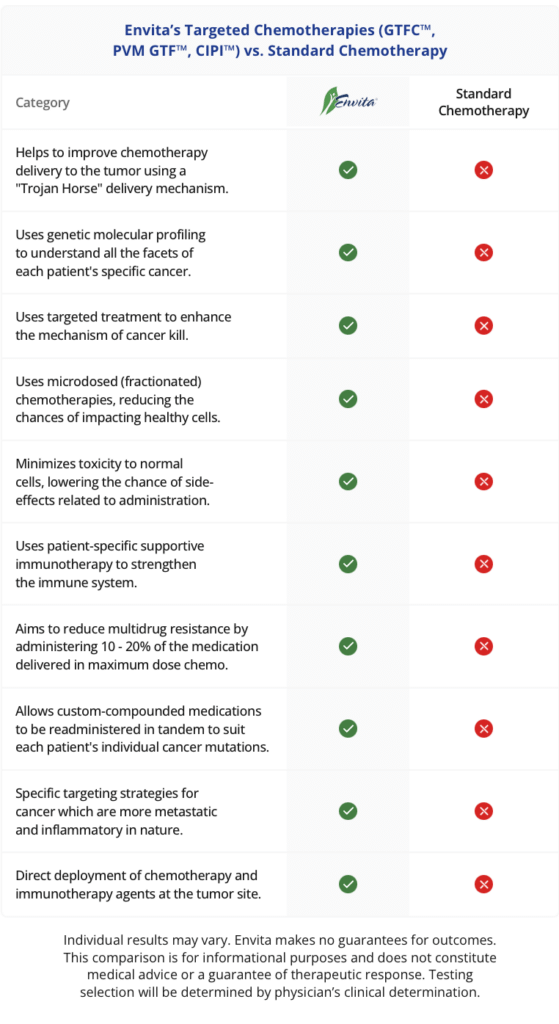
Wow! Sounds fantastic, right? Here’s the thing. Neoadjuvant chemotherapy (chemotherapy given prior to surgery with the intent of shrinking the tumor to make an unresectable tumor resectable or to make the surgery to resect the tumor less extensive) is an accepted treatment for potentially resectable metastases from colorectal cancer. However, it is usually reserved for tumors that are borderline resectable. Reading between the lines, what Envita appears to have done is simply to give its proprietary concoction of chemotherapy, which it calls GTFC™ (Genetically Targeted Fractioned Chemotherapy), a “proprietary treatment utilizing not only low doses of targeted chemo agents, but it also enhances the impact on cancer cells by utilizing novel therapeutic windows induced by natural and integrative medicine” that delivers “targeted chemotherapy to the tumor by using a ‘Trojan Horse’ delivery mechanism.” A “Trojan horse” delivery system attaches the therapeutic drug to a vehicle that seems harmless to the body but delivers the drug to the cancer cells more specifically. Such vehicles can include antibodies, modified immune cells, nanoparticles, and viral vectors. Do we know how the drugs were delivered or what drugs were used? Of course not! The mixture is proprietary!
GTFC™ is, however, likely chemotherapy, possibly mixed with immunotherapy. Does it work better than conventional chemotherapy? We have no way of knowing because Envita didn’t publish any clinical trials testing GTFC™ versus standard-of-care chemotherapy to determine whether it is more efficacious and less toxic. Could it work? Possibly, but, again, even if it does work, we don’t know how it compares to standard-of-care. Its efficacy might have been similar to, lower than, or greater than conventional chemotherapy. We have no way of knowing. In any case, Christian is alive mainly because of conventional treatment, especially the surgery, but, as is the case in most alternative cancer cure testimonials, he attributes his good fortune to the “alternative” cancer therapies that he had chosen to pay tens or hundreds of thousands of dollars to undergo.
The same likely applies to Envita’s other “proprietary” concoctions, including PVM (Platelet Vesicle Medication) GTF™, whose delivery, if you believe Envita, “is designed to selectively affect the inflammatory microenvironment of tumors and cancer cells,” and Chemo Immuno Precision Injections (CIPI™), described as a “minimally invasive proprietary treatment for deactivating tumors by deploying anticancer agents directly at the tumor site” using interventional radiology. I can’t help but note that we’ve tried injecting therapeutic substances directly into tumors for literally decades, if not hundreds of years, and the track record is, in general, poor. How is Envita’s CIPI™ any different? It’s not, really, given its description as “customized immunotherapy treatments that are combined with adjuvant agents and deployed directly inside the tumors of concern.” Again, this sort of thing has been tried before with at best mixed success many, many times, which makes it incumbent upon Envita to prove that its protocol actually works.
Let’s take a look at a couple of tables Envita includes in its description, first for GTFC™:
And for CIPI™:
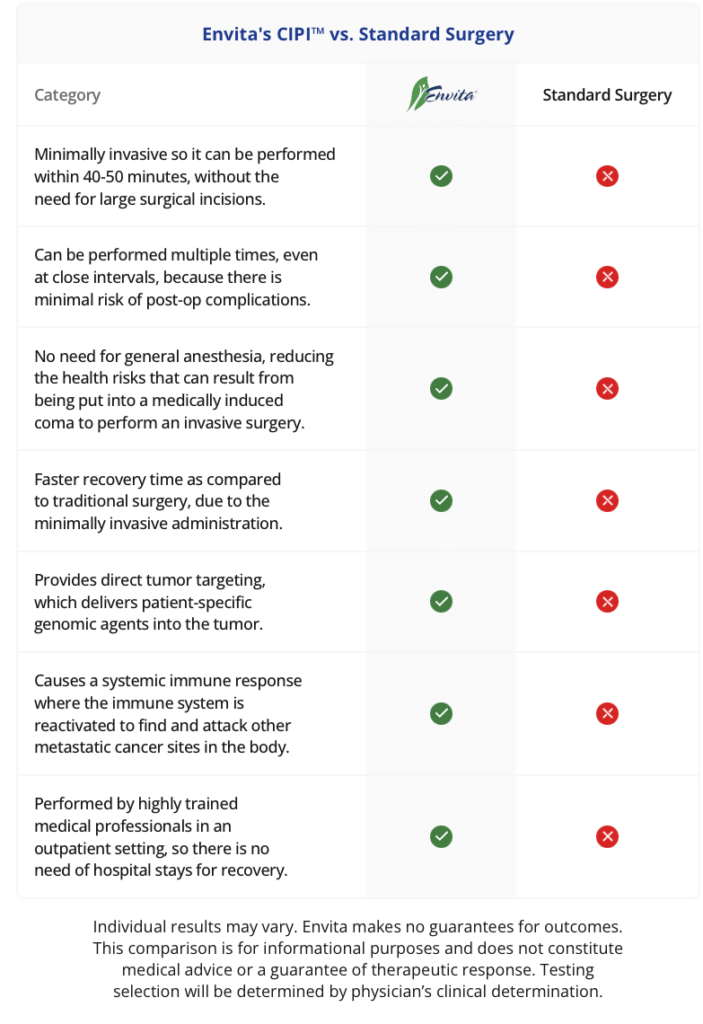
You can see how Mr. Thadani would have been impressed by such tables and such descriptions of the treatments offered at Envita! They sound so much better than what he had experienced undergoing just one round of the chemotherapy for stage IV lung cancer that had been recommended. Add to that testimonials, such as this one from a man with stage IV prostate cancer who was asymptomatic at the time of his diagnosis and whose cancer was only discovered by PSA testing who claims to have had his PSA return to normal under Envita care but does not say whether imaging studies show his cancer to have regressed after the CIPI™ treatments; a woman with stage IV breast cancer metastatic to bone who, if her cancer was estrogen receptor-positive (as 70% of breast cancer is) could potentially survive quite a few years under conventional treatment but attributes her doing so well to Envita; and a man with a cutaneous B-cell lymphoma that was clearly very indolent given that he had survived “decades” with it prior to Envita. One thing I noticed about these testimonials is that they all rely on tumor markers to say that the cancer had responded to treatment; I looked for descriptions of imaging studies and found almost nothing.
Then there was this testimonial of a woman with “stage 2 triple negative breast cancer.” The first thing to note is that stage 2 breast cancer is treatable for cure. In the case of the triple-negative variety, a stage 2 cancer would be treated first with neoadjuvant chemoimmunotherapy according to the KEYNOTE-522 protocol, followed by surgery and, if the breast is saved or there is found to be tumor in the axillary lymph nodes on the side of the cancer, radiation. With such treatment, one can expect a five-year recurrence-free survival in the 80% range. The neoadjuvant treatment produces a pathologic complete response rate (no tumor found in the surgery specimen) higher than 60%. This is all very standard. However, reading and watching the patient’s story, I found it hard to tell if she was being represented as metastatic. It’s not even clear whether she ever underwent surgery or how long she has survived since her diagnosis.
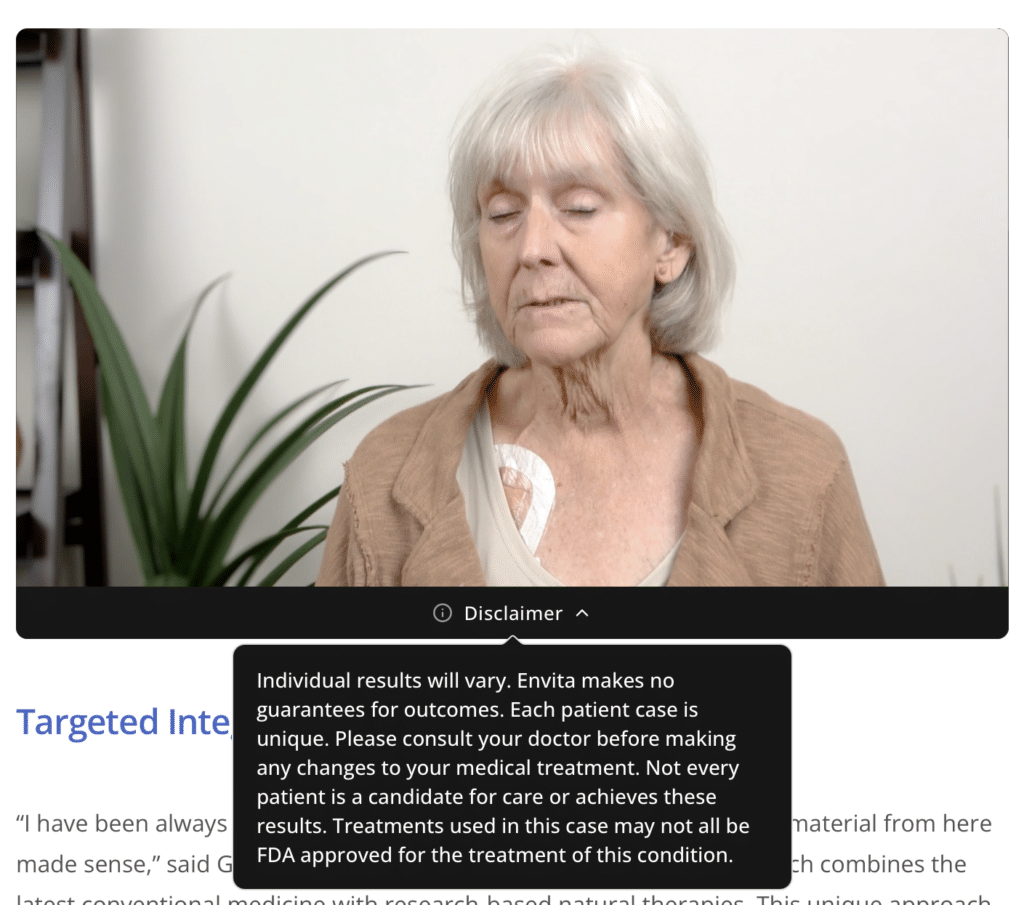
Basically, all the testimonials, as described on the Envita website, are pretty useless for determining whether Envita’s claims of efficacy are true. There’s just not enough information provided.
So what did Mr. Thadani receive? I think it’s worth quoting again here, because it was a naturopathic quack who first went over the treatment plan and what it would cost:
The naturopath turned to a whiteboard behind him to explain Envita’s “proprietary” chemotherapy regimen ($2,315 per treatment), which included lowering my dad’s blood sugar with insulin and delivering low doses of chemotherapy into his body. The side effects would be minimal, he said, far less than what my father felt with standard chemotherapy. Envita would also send him to a clinic it operated in Mexico to receive a cell therapy ($125,000) that the naturopath said would help his body fight off whatever cancer cells remained.
While I was sitting in his office, a nagging thought emerged: What if Envita actually had the secret cure for my dad? Its treatment seemed sophisticated, thoughtful and promising. The naturopath said his own father was successfully treated at Envita — evidence of how much he trusted the protocol that he was recommending for mine.
Those are the things that I remember, at least. Now, looking through my dad’s medical records, I can also see that his treatment plan came with a battery of what Envita calls “supportive” therapies. Many of them had little to no clinical evidence supporting their use in cancer care. They included infusions of hydrogen peroxide ($215 per infusion); a therapy that included adding medical-grade ozone gas, a known toxin, to his blood (also $215 per infusion); and coffee enemas, which carry side effects such as rectal burns and severe infections. If the naturopath told us about these specific therapies with the risks clearly outlined, I didn’t hear it. By that point, my skepticism had largely fallen away, and I heard what I desperately wanted: that the clinic was safe and effective.
Here’s a hint about these clinics. If it sounds too good to be true, it is. These clinics do not have “secret cures” for cancers that conventional oncologists cannot treat for cure, but only palliation. Unfortunately:
It’s one thing for a doctor to inform you of all the clinical trials, the rigorous scientific evidence, the percentage chance of one therapy working over the other. But it’s another to be looked in the eye by another human and told that your suffering is real and that you will be OK, and to hear that there is, in fact, a secret cure, a magic bullet. Looking back on those desperate months with my father, I can see clearly how much he valued the feeling of his care above anything else.
This is precisely how these clinics lure their patients in.
Also, note the “supportive care.” As I’ve discussed many times right here on this very blog, coffee enemas are pure quackery associated with the Gerson therapy, and infusions of hydrogen peroxide are also not only unproven but disproven. However, the business model of clinics like Envita and Hallwang is to pitch “integrative care,” “the best of both worlds” that supposedly combines the best of cutting-edge medicine that’s so cutting-edge that nothing about its efficacy or safety has been published or even subjected to clinical trials, plus rank naturopathic quackery.
In fact, the cancer therapy is often quackery too. Did you notice that part about “lowering my dad’s blood sugar with insulin and delivering low doses of chemotherapy into his body”? That’s obviously a rebranded form of a cancer quackery known as insulin potentiation therapy, which is known not to work and is also potentially dangerous if a patient’s blood sugar is lowered too much. (Read this article on Quackwatch about IPT if you want the details. In fact, it makes me wonder whether the GTFC™ therapy being sold by Envita is nothing more than IPT in which the “low dose chemotherapy” is chosen in a make-it-up-as-you-go-along manner based on various genetic tests.
The overall cost is a familiar story too:
At this point, the costs were staggering: around $200,000 since moving to Arizona, a price that mostly included invoices from Envita. There were also scans and outside therapies the clinic recommended, like “colon hydrotherapy,” a treatment that supposedly cleansed toxins from his body (though there’s little scientific evidence to support it). This accounting does not include all the supplements he needed to take, which at one point was 14 different pills, twice a day.
His Envita medical records from this time detail his lethargy, his cough and his precipitous drop in weight. At certain points, the records show, Envita’s doctors referred my dad to the emergency room or to an outside pulmonologist when his symptoms got particularly bad. But there were also a few bits of good news that my dad clung to. In January, he was told that there were some signs of improvement in his lungs and that the lesions in his brain — which were being treated by an outside radiation oncologist — were disappearing.
Any positive news contrasted with the person we were seeing — a man suffering and shrinking, a husband and father wasting away. My mom, desperate to return to her support system in New Jersey and horrified by my dad’s rapid decline, suggested that they go back to Memorial Sloan Kettering — or, at the very least, call the oncologist for a second opinion. But my dad refused, saying that Envita’s treatments were just running their course.
Notice how Envita was falling back on conventional medical care to treat the brain metastases and was trying to send him to the emergency room because he was so obviously deteriorating. I note that, prior to this, according to the NYT article, Mr. Thadani had done pretty well for a few months. He felt reasonably well, and the environment at Envita when he went for his treatments was quite pleasant, with an attentive staff. Again, this is not an atypical story after a patient stops chemotherapy and his cancer has not yet progressed enough to worsen his symptoms. Ms. Thadani recounts how, when her father finally ended up in a nearby hospital in the ICU because his breathing and oxygen saturation had deteriorated so much, the ICU doctor asked where his cancer was being treated. When informed that it was Envita, he told them that he saw patients like her father “all the time” coming from Envita, concluding, “You wasted your money.”
I agree with Ms. Thadani that such a response from a doctor was quite callous and totally inappropriate. On the other hand, even Ms. Thadani became more understanding of that doctor when she did more investigating and found that Envita had a long history of investigations and complaints about “selling treatments ‘at a high cost to desperate subjects’ and administering unapproved drugs to vulnerable, end-state cancer patients.” She also learned that Envita was far from unique, noting that she had “found dozens of similar businesses around the country that provide cancer patients with costly, unproven treatments” and “spent months trying to figure out what kind of oversight exists for such clinics, only to discover a confusing patchwork of laws that vary from state to state.” From my perspective, that doctor’s response reminds me very much of a news report from Panorama on the Burzynski Clinic in which an interview with Dr. Jeanine Graf of the Texas Children’s Hospital, a pediatric intensive care unit doctor, detested Burzynski and took care of many of his patients who had deteriorated while being treated with his quackery.
At the risk of injecting myself too much into this story, which is really about how an alternative cancer clinic takes advantage of desperate patients, I can’t help but think that I wish she had discovered me and called me. I could have helped her so much with her story. At least, I like to think that I could have, and I wish I could have, given how much the story of her father moved me, being so similar to a number of stories that I had written about and analyzed over the years. My own self-absorption aside, one part really got to me. After noting that “it felt as if there were two options: treatment at any cost or death and how she “cannot remember a moment when the third option — acceptance — even crossed our minds,” she describes deciding to take her father off his ventilator and how he took much longer than expected to finally pass away, and how he kept wanting fenbendazole to save his life, apparently having discovered “turbo cancer” quack William Makis before his condition deteriorated, noting in the accompanying interview that her “dad spent some of his final conscious moments yelling at us to give him some.”
Moreover, this part of her story didn’t surprise me in the least:
Alternative treatment protocols like the one my dad received at Envita are often not covered by insurance and can cost families tens — if not hundreds — of thousands of dollars. My parents were able to shoulder the expense, but there are many whose decision to seek care drives them into serious debt. I came across hundreds of GoFundMe pages of people asking their communities for help and spoke to several families whose loved ones sold off assets or ran through their small savings to afford such treatments. Some claimed they were betrayed or misled by their clinics but felt their only recourse was to write a bad online review. (I would also later leave Envita a one-star review online.)
It’s just a fancier version of the Burzynski Clinic, and, yes, I’ve written a lot of stories about desperate families using GoFundMe and other such crowdsourced funding sites to pay for cancer quackery. It saddens me to see that the situation remains basically the same as when I first discovered it 20 years ago.
Will MAHA make things worse?
One point that Ms. Thadani makes that led me to start thinking about one of my “favorite” topics again is about the mistrust of the medical establishment that her father had been harboring before his cancer diagnosis:
As this unfolded in the fall of 2019, I dismissed my dad’s choices as an extreme reaction by someone who had long preferred natural remedies and didn’t like going to the doctor. But that was before the pandemic eroded trust in the medical system and the Make America Healthy Again movement elevated such skepticism into the federal government. Now I look back on my dad’s aversion to conventional medicine and realize it was more than just personal eccentricity; it was also an intimate preview of an ideology that was on the brink of going mainstream.
As my dad was, patients today are inundated with misinformation spread by alternative-medicine practitioners, social media influencers and public figures. They are willing to experiment with unproven therapies, often at great physical or financial risk, in part because they want more personalized and empathetic care — an antidote to the famously harsh aspects of traditional medicine.
This tension is nothing new. “Integrative medicine” frequently advertises itself by portraying conventional medicine as cold, bureaucratic, too scientific, and not caring about the individual patient, while wrapping itself in the human touch. Unfortunately, thanks to the manner in which we as a society choose to construct our medical system, there is more than a germ of truth in this. The deception, whether self-deception or intentional, comes when alternative and “integrative” medical practitioners try to claim that the only way to remedy this lack of the human touch is to “integrate” quackery into medicine.
Now that MAHA is firmly in control of the federal government and likely to remain so for at least the next couple of years, I fear that things will only get worse. For example, I long ago warned about how “right-to-try” laws, which give patients the “right to try” any experimental drug or therapeutic if it has passed the minimal safety bar of a phase I clinical trial, would eventually be turned into profit centers, as Envita openly admits how it’s using right-to-try as the basis for its combining experimental therapeutics that haven’t been FDA-approved yet with FDA-approved conventional therapies (although not necessarily FDA-approved for the combination given or the cancer being treated). It reminds me very much of clinics using 3-bromopyruvate a decade ago to treat cancer, even though it was not then FDA-approved.
Trisha Thadani describes a problem that is very old. As I like to say, there’s nothing new under the sun. She also describes how the “coldness” of our current system, combined with the distrust of the medical system that people with her father have harbored for a long time, can lead to the proliferation of alternative clinics such as Envita that satisfy people’s emotional needs to be treated seemingly as an individual, at least at first, but do so in service of a business model that sells unproven and disproven cancer treatments, along with rank quackery like coffee enemas and intravenous ozone in the guise of “supportive care.” MAHA has weaponized this distrust, and its ongoing project to chip away at laws and regulations that protect patients, even as poorly as they currently do, against alternative cancer clinics like this made it very likely that there will be many more Envitas forming and many more people like Rajeev Thadani being victimized, leading surviving daughters like Trisha Thadani to say:
Hope is a delicate thing in the face of a fatal disease: It can give a patient like my dad the will to keep going, but it can also blur easily into false expectations and questionable decisions. It’s a tricky balance that looks different for every patient and family. Instead of chasing an elusive cure, I wish my dad had taken more time to say goodbye and celebrate a life well lived.
Selling false hope is what these clinics do. It’s also what MAHA does, as long as it can profit.